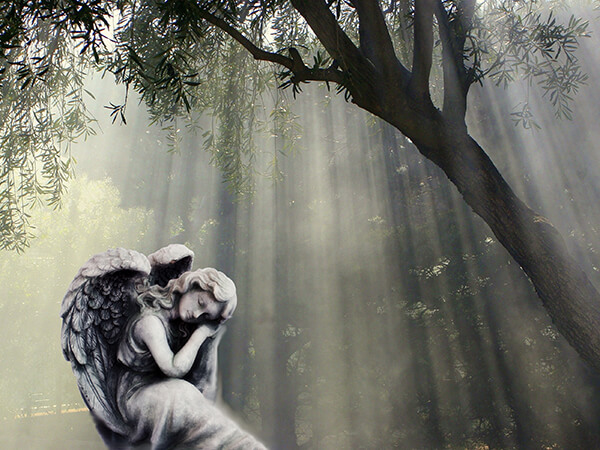
Field notes on the losses we are allowed to mourn, the ones we are not, and the long night in the forest that comes with all of them.
Grief is one of the purest emotions I know. Because it does not discriminate. I don’t care if you have the heart of Mother Teresa or you’re bitter and full of anger, it doesn’t care if you’re rich or poor, busy or bored. It just doesn’t matter. Grief comes for everyone.
And it doesn’t leave until it’s done.
Nobody tells you that grief does not run on the schedule you expect. We are handed a picture of it early: the loss happens, the sorrow follows, you move through some tidy sequence of stages and eventually you arrive somewhere called acceptance, presumably with better posture.
That is not what happens.
What happens is that grief arrives when it decides to. Sometimes eighteen months late, in a grocery store, over a bag of fig newtons. Sometimes it never announces itself as grief at all, and instead shows up as a bad year, a short temper, a shoulder that will not release, an inability to sit still in your own house.
And it comes for far more than death.
The goodbye the illness took
If you have been a caregiver, you already know the thing that is hardest to say out loud.
By the time the person actually dies, you may have nothing left to feel with.
The months before a death are not a slow farewell. They are a job. There is medication to track and appointments to drive to and a body to move and insurance people to argue with and a house that still expects to be maintained. There is the constant low static of listening for a sound in the other room. There is the way your own body starts to fail in small ways because it has been running on adrenaline and interrupted sleep for longer than a body can do that.
And underneath all of it, the thing nobody puts on a casserole card: somewhere in there, you begin to want it to be over.
You want their pain to stop. That part is easy to admit. But you also want your own to stop. You want to sleep. You want to stop watching someone you love be dismantled in front of you. You want your family to stop breaking. You want, for one hour, to not be needed.
And then they die, and you feel relief, and the relief horrifies you.
I want to say this as clearly as I can, because I think a lot of people are carrying it silently: relief is not the opposite of love. It is frequently the evidence of it. You cannot be relieved that someone’s suffering ended unless you found their suffering unbearable, and you do not find suffering unbearable unless you love the person underneath it. The relief is love, arriving in the only form it has left.
The other loss, the one that goes unnamed, is the goodbye you never got. The sweet one. The one where you sit together and say the true things and there is enough time and enough presence for it to be meaningful and bring closure.
You did not get that because you were emptied out. Because by month nine your emotions had gone quiet in order to keep you functional, and the blunting that let you change a dressing without falling apart is the same blunting that was still in place at the end. You were not cold. You were conserving. That is what a nervous system does when the demand exceeds the supply.
The illness took the goodbye. Not you.
And you may spend years litigating a case in which you were never the defendant.
The stages nobody lists
Here is the sequence I have actually observed, in myself and in people I love.
First, relief. Brief, immediate, immediately followed by guilt for having felt it.
Then survival. There are things to be done. There is a service, and paperwork, and a house to empty, and people to call, and someone has to be the one who is holding it together, and you are extremely good at being that person, which is precisely the problem.
Then numbness. Months of it. You function. You go back to work. People tell you that you are handling it beautifully and you accept the compliment while feeling like a fraud, because you are not handling anything. You have simply not started yet.
And then, somewhere between a year and two years out, on an ordinary Wednesday with no anniversary attached to it, the floor gives out.
I have come to believe this is not a malfunction. Grief will not open the door while you are still carrying the load. It waits for safety. Your system has to be reasonably certain that nothing else is about to be required of you before it will let you feel the size of what happened, because feeling the size of it makes you temporarily useless, and you were not permitted to be useless.
So the delay is not avoidance. The delay is the body’s good judgment.
Which means the grief that arrives two years late is not late at all. It arrived the moment it was possible.
Grieving the living
And then there is the other kind, which can be worse, and which almost nobody will let you call grief.
Someone leaves. Or you leave. Or the thing simply ends and neither of you can explain how. And they are not dead. They are somewhere in this world right now, breathing, eating breakfast, and they are as gone from your life as anyone in a grave.
There is no funeral for this. Nobody brings food. There is no socially agreed period during which you are permitted to be a wreck. You are expected to be over it on a schedule that other people find convenient, and if you are not, there is a word waiting for you: obsessed, stuck, unable to move on.
And there is a cruelty in it that death does not have. The dead cannot choose differently. The living can, and don’t. Every day they remain alive and absent is a small renewal of the decision.
But here is what I think is actually happening, and why it hurts in a way that seems out of proportion.
You are not only grieving a person. You are grieving a future.
You had built something. Not on purpose, and often without noticing. A version of the years ahead with them in it. The trip you were going to take. The house. The way holidays were going to work. The shape of an ordinary Sunday five years from now. Their family, who you had started to think of as partly yours. The self you were becoming in their presence.
All of it dies at once. And a future has no body, so there is nothing to bury and nowhere to put flowers. You are mourning something that never existed, which does not make the mourning less real, because you were living in it. It was real to your nervous system, and your nervous system is what is doing the grieving.
Grieving the self you have to leave
Then there is the loss almost nobody counts, which is the one that happens on purpose.
Growth is a bereavement. We talk about it as though it were only gain: you become more conscious, more integrated, more yourself, and everyone applauds you. But something has to leave for that to happen, and the thing that leaves was yours. She got you here. She had strategies that worked, armor that held, a way of moving through the world that kept you alive for years.
And you are being asked to set her down. Not because she failed, but because she is no longer necessary, which is somehow harder to accept.
We do not only mourn what we lost. We mourn who we were when we had it.
And there is a fear underneath the resistance that I do not think is silly: what if I need her again? What if I set this down and the world proves me wrong about being safe enough to have set it down? What if the new version cannot do what the old one could?
Usually she is replaced by something better. Sometimes she turns out to have been unnecessary the entire time. But you cannot know that in advance, and you have to release her anyway, in the dark, on faith. Which is its own small grief.
The losses no one calls grief
A house. A job. Money and the safety it bought. A body that used to be able to do a thing it can no longer do. A faith you held your whole life and cannot hold anymore. A hobby. A city. A season of life that was good and is over and will never come around again in the same configuration of people and light.
We are told these are problems, not losses. Adjust, adapt, be practical, be grateful it is not worse.
But our identities are woven into the things we love. When the thing goes, some part of the self-description goes with it. I am a runner. I am a person who can afford this. I am someone who believes. I am the one who takes care of everyone. Pull the thing out and there is a hole in the sentence you use to describe yourself, and that hole is grief, whatever the paperwork calls it.
Losing capability may be the hardest of these, because the person you are grieving is standing right there in your own body, unable to do what she used to do.
Was any of it ever mine
This is the question I keep arriving at, and I want to handle it honestly, because it can be used as a bludgeon.
The truthful answer is no. Nothing was mine. Not the person, not the house, not the health, not the version of the future I had already half-furnished. All of it was lent, generously, for a while.
But I refuse to let that become a reason to stop crying.
There is a particular spiritual move where someone tells a grieving person that their loss was an illusion, that attachment was the real problem, that they should never have been holding on in the first place. It sounds like wisdom. It functions as dismissal. It asks a person in pain to solve their pain by deciding it was never warranted.
The thing was not an illusion. It was real while it was here. The impermanence does not retroactively cancel the experience any more than the end of a song makes the song not have happened.
What was never real was the ownership.
And that is a much smaller correction than it sounds like, but it changes the character of the grief. I am not being robbed. I am being asked to give back something that was on loan, and that I would take again knowing the terms.
Not detachment. Non-attachment.
I have never liked detachment. It reads as a strategy for people who would rather not be here.
Detachment says: I will not let it all the way in, and then it cannot take anything from me when it goes. That is not peace. That is preemptive loss. You lose the thing at the beginning instead of the end, and you call yourself wise for it.
Non-attachment says something much more demanding. Come all the way in. I will love you completely, and I will not require you to stay.
That is the hardest thing I have ever tried to do, and I do not have it. I can articulate it beautifully and fail at it in the space of a breath. Because the moment something good arrives, some part of me immediately begins constructing a future in which it continues, and the moment I have built that future I have created something new that can be taken from me. I did not lose the thing. I lost the projection I made of it.
Most of my suffering is not about what left. It is about the story I created around it. The story came to an end, and not like the book I wrote.
What the Parasite does with grief
Grief itself is clean. It is enormous and it takes you apart, but it is honest. It says: this mattered and it is gone.
The Parasite does something else. It writes the epilogue.
It will never be the same. You will never feel that way again. This is what your life is now. Everyone leaves you eventually. You should have known. You should have done more.
Notice that none of that is grief. Grief has no opinion about the future; grief is entirely about what was. Every sentence that begins with never again is not sorrow, it is prophecy, and it is being delivered by a frightened voice with no access to information about tomorrow.
And there is the quieter move, the one I catch in myself and dislike: grief slides into a story in which I am the one this happened to. The center of it. Not a person who loved someone and lost them, but a person to whom loss keeps happening. It is a small shift and it changes everything, because sorrow can move through you and self-pity cannot. Self-pity has to be maintained.
I do not say that as an accusation. The pain drives us there. It is the path of least resistance when you are exhausted. But it is worth knowing the difference, because one of them ends.
Grief is a passage, not a residence
I believe we are meant to grieve completely. Not gracefully. Not in a way anyone would want to watch. As though the skin has been taken off, howling if howling is what wants out, for as long as it takes.
Because grief is not really an emotion. It is a movement. It is something passing through, and its entire nature is that it is in motion. All emotions are energy and it must pass through us.
What does not move does not vanish. It relocates. It becomes a shoulder that will not loosen. A stomach that stops working properly. A tiredness that sleep does not touch. A sharpness with people who did nothing. A door in the house you stop opening. Anyone who has watched someone hold grief for twenty years has watched what unmoved feeling does to a body.
So it has to live in you for a while. It should be given a room and a season and no deadline.
And then, at some point that only you can identify, it has to be allowed to leave.
That is not the same as letting go of the person. You never have to do that, and I would not do it if I could. It means letting go of the grip. There is a difference between carrying someone and clutching them, and only one of the two lets you keep walking.
Sitting in the dark of the forest
Which brings me to where all of this actually lands, which is not a conclusion but a position I keep having to take up again.
If nothing is owned and everything is on loan, then the only thing I actually have is this. Right now. This hour, this light, these particular people who are currently alive and reachable.
That is not resignation and it is not an argument against planning. Hope for a beautiful tomorrow. Build toward it. Want things, specifically and greedily. Just hold the outcome loosely, because the outcome holds no guarantee.
And it means sitting in the dark of the forest. Through the night. With all of the noises and none of the knowledge. Not knowing what happens next, and not being handed anything to make that bearable.
I am not good at this.
I get paralyzed. I have spent whole seasons wrapped so tightly in my own pain that I could not move or see, mummified in it, unable to take the next step because I could not confirm in advance where it would land. Fear has crawled in bed with me like a lover, many nights, and stayed until morning. It still does, sometimes. Less often. But it knows the way.
And I know all of this. Everything I have written here, I know. Knowing it has not made me good at it. That gap between what I understand and what I can actually do in the dark at three in the morning may be the most honest thing on this page.
But here is the one thing I have learned to hold onto out there.
The night in the forest is not a test you have to pass. It is a night. It ends because nights end, not because you were brave enough or wise enough or sufficiently healed. You do not have to be good at the dark. You only have to still be there when it lifts.
And some morning, and I cannot tell you which one, the light comes through the trees at a low angle and you notice it, and you realize you are noticing it, and that the noticing came back without your permission and without your effort.
That is grief finishing its passage. Not leaving you unchanged. Just leaving.
And whoever you lost would want you to see that light. I am fairly sure that is the only thing any of them would want.