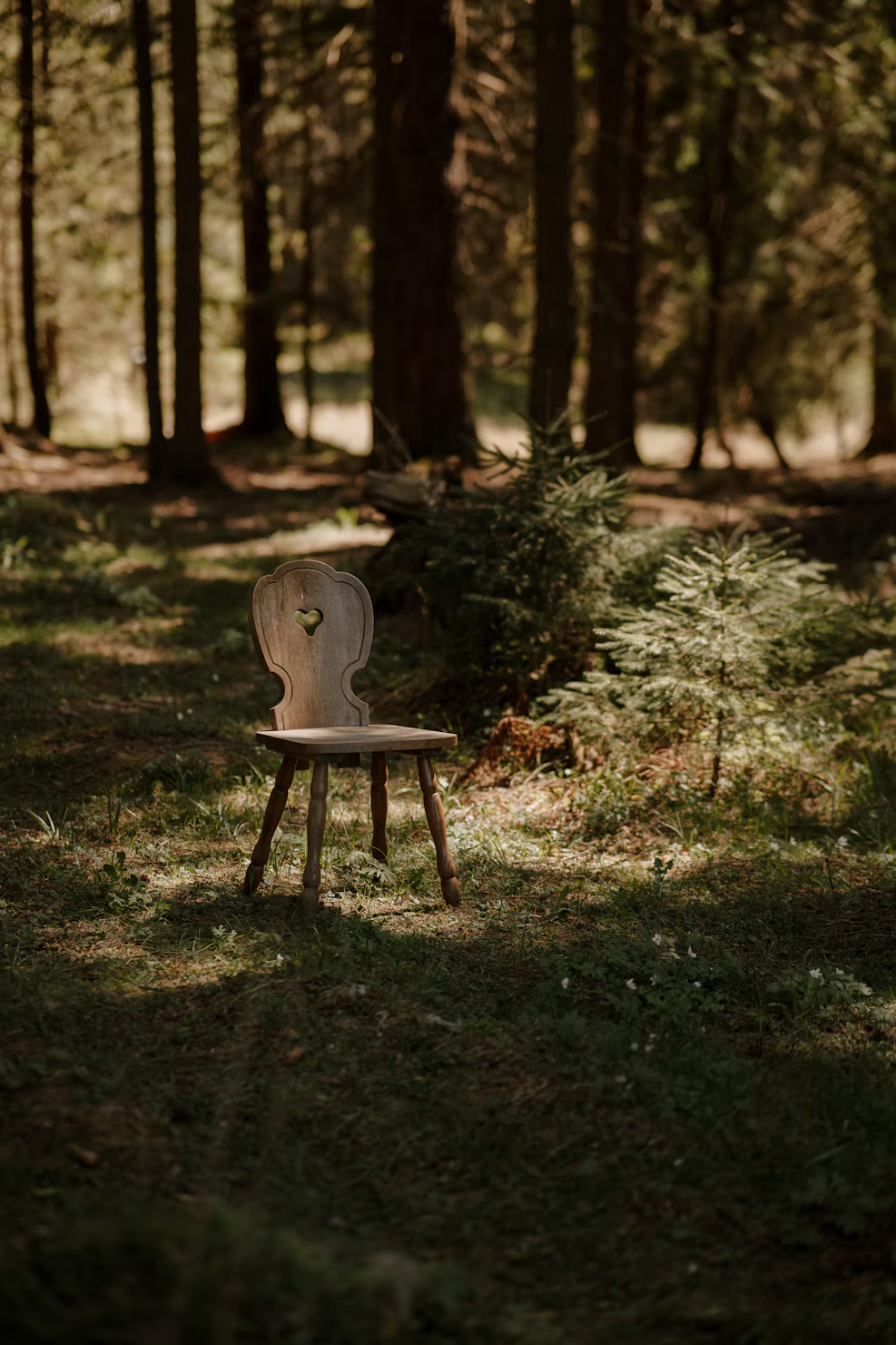
Field notes from twenty years of watching people argue about whose fault it was, and the night I finally saw myself in both chairs.
For more than twenty years, I have sat across from couples while they argued about whose fault it was. People desperate for clemency.
There are always two chairs, and there is always a case being tried. They arrive with evidence: dates, screenshots, the thing that was said in the car on the way to dinner six months ago. Each of them has built an argument that is airtight from the inside, and each of them is quietly waiting for the other person or the person in my chair to open the file, read it through, and finally say the words. You were right. It was them.
I have never once been able to give that verdict. Not because I lacked information. Because, as far as I have ever been able to find, the verdict does not exist. There is no villain ever.
What I can give is what the witness sees. And the witness sees the same story over and over, told from two sides by two people who are each certain they are the only one seeing the truth.
She is usually the one who called to make the appointment. Sometimes it is he. The gender changes. The shape of the dynamic does not. Always one is reaching and one is pulling away.
There Is One Who Reaches
When the person one loves pulls away, the other panics. It never looks like panic from the inside. It looks like questions. What’s wrong? Did I do something? Why are you being like this? Then more questions, then an argument that circles faster and louder, because the not-knowing feels like falling and the only thing within reach is the other person.
It rarely lasts long. A few hours. Sometimes a day. But I have watched enough of these storms to know that their length and their damage are measured in different units. Some of what breaks in those short, hot stretches never grows back.
The one panicking usually knows exactly where it comes from. They can name the old wound, the early lessons about a love that was fully present one moment and gone the next. They could explain it to me better than I could explain it to them. And it does not stop them at eleven o’clock at night when the silence on the other end of the phone gets loud.
Their part is real. It is theirs. And it is the part everyone in the room can see.
The One Who Retreats
Another sits in the other chair, and their experience is just as real.
Something shifts in them, quietly, and they need room. Not forever. They just need to hear their own thoughts again. And the moment they step back, the other partner steps forward. A text, then three more before they have answered the first. Each one landed on a body that was already full. The room they needed just got smaller, and the walls started to move in.
Being pursued when you are already overwhelmed floods you. It can make someone you love feel like something you have to survive. I have watched that flood cross a client’s face in my office, and I believe them.
But the witness sees something else, too. Not every retreat begins with the other person. There are stretches when things between them are good, really good, and then the temperature drops for no reason anyone can find. The other partner was not asking for anything. Nothing on their side had moved. Something old and private stirred in you, something that had nothing to do with them.
And then they react. And once they react, their reaction becomes the whole story. Whatever started inside of you disappears from the record. Their panic or reaction gets promoted to cause. Because their response was real, and sometimes ugly, it is very easy to point at.
No One Fights Alone
This is one of the quietest injustices I have witnessed in love. Not that we are held accountable for what we did; we should be. It is that what one person did gets used to cover what started it.
Here is the thing the witness sees that neither person in the room can.
When I go back through the worst nights with them and read their texts, every message either sent was answered. Every one. The fire one of them is blamed for starting was being fed from both sides.
One person can panic alone. One person can plead into the dark. One person can withdraw and get angry. But one person cannot keep a fight going for days. That takes two people, both answering, both escalating, both lost in the turmoil of their emotions.
So I ask the question almost nobody in that kind of fight has asked: What would have happened if, at any point, either of you had simply stopped? Not with a punishing silence. With something like: Let’s not do this tonight. I love you. We will talk tomorrow when we are both on the ground again. And then taking the high road and stepping away from the fray.
Either of them could have. Neither of them did. That is the nature of a cycle. It is a dance, and a dance needs two people moving, and the partner who insists they were only ever being dragged across the floor has not yet looked down at their own feet.
It is the act of an ill-instructed man to blame others for his own bad condition; it is the act of one who has begun to be instructed, to lay the blame on himself; and of one whose instruction is completed, neither to blame another, nor himself.
Epictetus, Enchiridion
Most couples I sit with live swinging between the first two stages. It was all you. No, it was all me. The third stage is not innocence. It is clarity: the ability to see that they both hold pieces without needing anyone convicted.
The Ledger
After the storm comes the accounting, and I can almost predict the sentences.
Each of them wants forgiveness for what they did in the heat of it: the raised voice, the accusing, the behavior they are ashamed of, the cruelty that slipped out sideways. They were both upset. “That isn’t who I am.” And at the same time, each of them keeps meticulous records of what the other one did.
But a real argument is a place where two people have lost hold of themselves. Both of them. To forgive yourself for losing control while holding the other person’s loss of control against them indefinitely is not fairness. It is a ledger kept in one direction, and no relationship survives being audited by a single bookkeeper. It is a righteous ego that does that.
Out beyond ideas of wrongdoing and rightdoing, there is a field. I’ll meet you there.
Rumi, translated by Coleman Barks
The Rule That Cuts Both Ways
There is a sentence I hear in nearly every one of these rooms, usually from the one who retreats: It is not my job to hold space for their anxiety.
It is true. It is not.
But a true thing has to be true in both directions, or it is not a principle. It is a weapon. If their fear is theirs to manage, then the overwhelm is also the responsibility of the one who feels overwhelmed. The tightening in the chest when one reaches. The heat that rises with the third text. The sharpness. The going cold. If it was never one’s place to hold space for the other’s anxiety, it was never one’s place to hold space for the other’s sensitivity.
Love is, in part, the choice to be gentle with each other’s wiring. But gentleness offered freely is a gift. Gentleness demanded with a price is a tax, and the person paying it eventually goes broke. And what is seldom seen is that so does the receiver of the gentleness.
Everything that irritates us about others can lead us to an understanding of ourselves.
Carl Jung
The Questions I Learned to Ask
Over the years, I stopped trying to settle the case and started handing each of them questions instead. Read them slowly. If one makes you want to explain yourself, that is the one. Stay there.
When you have felt discomfort around someone else’s behavior, were you always right about what was happening? Was it really them? Or did some of that pressure start inside you, and it was easier to call it theirs?
If you had clearly and calmly communicated what you needed and shared that it wasn’t about them, told them what you were going to do and what it might look like and feel like to them, would things have gone the way they did? Or did your absence or poor communication leave them to write the story alone? Did you expect them to just know and be able to control their emotions when you weren’t in control of your own?
No matter how much your anxiety gripped you, were you justified in panicking and responding to that? And no matter what your fear or discomfort told you, were you justified in your actions? Is there justification for any of it?
When your words said one thing and your actions another, or when something was not understood and they asked for clarity, did you hear the question as an attack and add more fuel to the fire? Did you start creating a defense or, even worse, a battle strategy? And then later, was it just too scary to look at yourself?
When they pulled away or reacted in a certain way, did you ask what it meant and how it was being experienced by them, or did you decide what it meant and then react to your own decision?
When they reacted in a certain way, did your emotional pathways settle, or did they escalate to meet theirs? Were you responsible for your own escalation or did you make it theirs?
How many of your fights were with the person in front of you, and how many were with someone from much longer ago or the child or victim inside yourself?
When it was over, did you forgive yourself for what you said in the heat of it, and keep them on trial? Are they still on trial?
Have you, in your pain and hurt, made yourself the only one deserving compassion and clemency? Forgiveness is an internal release of bitterness, while reconciliation requires both people to rebuild trust over time. Do you expect immediate absolution, but not give it? How has this blocked reconciliation for you?
Do you need the people you love to behave a certain way so you can feel safe, and call it neediness when they need the same from you?
Is it possible you hold other people responsible so you never have to hold yourself?
What are you really afraid of? Because what you have been telling yourself is likely just a blanket you threw over the real thing. Are you willing to look and go deep? It’s probably deeper than you imagined, and it’s probably going to create a lot of discomfort. But will you look?
The Same Fear in Different Coats
Here is what twenty years in that chair have taught me: we kill the good things in our lives because we are afraid of how vulnerable they make us. And then in all our laziness we would rather walk away than do the hard work of facing ourselves and doing what it takes to work through it. And we lose real connection and love.
The one who retreats goes cold, because if you never fully arrive, you can never be fully left. The one who reaches holds on harder, because if you grip tightly enough, maybe it can’t get away. They look like opposites. They are the same fear wearing different coats, and both of them strangle the very thing they are trying to protect.
The line dividing good and evil cuts through the heart of every human being.
Aleksandr Solzhenitsyn, The Gulag Archipelago
Everyone is broken. There is no healthy one in the room, patiently enduring the damaged one. There are just two people bumping into each other’s sore places in the dark.
Both Chairs
And now I have to tell you the truth about the witness.
I have sat in both of those chairs.
I have been the one who reached, panicking at a silence, sending one more message, trying so hard to explain, absolutely certain that if they would just understand everything would be fine. And I have been the one who retreated, going cold, needing room, quietly furious at being chased, absolutely certain that if they would just give me some space, everything would be fine.
Both times I was righteous. Both times I was indignant. Both times I could have laid the evidence out for you, dated and annotated, and proven beyond any doubt that the other person was the instigator and to blame. I knew all of this. I taught it. And I still could not see it when it was mine.
Even the witness chair was a hiding place. It is much more comfortable to see the pattern in other people’s lives than to feel it in your own body.
The truth finally caught up with me in a jungle far from home, in a plant medicine ceremony, on a night I went in desperate to see all of it and heal from it, whatever it cost. I did not get a gentle revelation. I got the whole tape, played back from both chairs at once. My panic and my coldness. The messages I sent and the ones I answered. Every story in which I had cast myself as the one this was happening to. There was nowhere left to stand except inside it.
And why beholdest thou the mote that is in thy brother’s eye, but considerest not the beam that is in thine own eye?
Matthew 7:3
I am not telling you the medicine fixed me. It didn’t. It showed me. The fixing is the work that comes after, and I am still doing it. I still feel the discomfort rise when someone goes quiet. I still feel the pull to go cold when someone gets close. Knowing all of this has not made me fearless. Some nights it barely makes me slower. But it has made me clear, and most of the time still enough to hear the storm coming. It has given me the time and awareness to sit quietly now.
The Relentless Inventory
Whatever we do not look at does not stay behind with the person we lost. It packs its own bags. There will be someone else one day, and the same fear will walk into the room first, and the same dance will begin.
The wilderness within us is so overgrown that most of us cannot see the forest for the undergrowth. Old thickets of defense, planted when we were small and needed somewhere to hide. Brambles of old stories. Clearing it is slow work, done by hand, one branch at a time. You get cut. You find things you did not want to find. Some of it grows back, and you clear it again.
Not everything that is faced can be changed, but nothing can be changed until it is faced.
James Baldwin
So I believe we owe ourselves, and everyone we will ever love, a deep and relentless inventory. Not a punishment. An honest count of what is on the shelves. This fear is mine. This silence was theirs. This wound came from long before either of us. This cycle we built together, and either of us could have stopped it, and neither of us did. We should have owned it together, and walked together to the other side. Avoiding the hard work in one relationship will not make the next one better. Regret does not undo it; only action does. And the rarity of love will rarely be replaced. But in our fear we lay it down. I challenge you not to; I challenge you to do the work alone and together. Because one is only healed in relationship, and no relationship that has the capacity to heal will be easy. Those are the ones that truly transform us and have the greatest gifts.
I am in the forest now, out of the witness chair, clearing what I can.
I hope you will come in, too. It is dark in here, and thick, and you will not like everything you find.
Come anyway.